Tag Archives: op-ed

right now

The Rule of Right Now.

By: Chris Warren

This summer there has been so many natural and man made calamities that I’ve become desensitized and hardly notice them anymore. There is no way to completely avoid being a victim, but there are plenty of ways the average person can, right now, decrease the odds of being involved in a tragedy and increase the odds of living through it if they are.

I call it the Rule of Right Now and here’s how it works: Wherever you are physically located while reading this, stop for a moment and look around you. Ask yourself: What is the most likely emergency/disaster event that could happen to me? And what is my plan if it happens right now? The Rule of Right Now states that we should train ourselves to always be aware of what could happen and have some kind of plan for dealing with it.

If you are at home in a safe neighborhood, coming up with a scenario may be difficult. That is the exact it can’t happen here complacency that makes victims unwitting participants in their own misfortune. Getting your head into right now requires some practice, and if you feel uncomfortable with the process, then you’re probably on the correct path.

The biggest barrier to being ready is denial. Denial creates at least as many victims as the tragedy itself.

The Rule of Right Now is universal. It goes beyond acute personal emergencies (such as a fire breaking out in your house) to very serious, widespread disasters that can effect an entire region or country (such as an economic crash). The biggest barrier to being ready is denial. Denial creates at least as many victims as the tragedy itself. A majority of people do not put even the smallest thought into what they would do if something horrible happened because they refuse to accept that anything horrible can happen in the first place.

It’s important to understand that the Rule of Right Now should not be interpreted as an endorsement for paranoia or an expectation that we should obsess over every conceivable disaster. Paranoia is a barrier, a distraction, to preparedness. It’s not sensible to be concerned with way out there scenarios that have a cosmically low probability of happening at the expense of ignoring obvious hazards. I personally know people who are think they are bad ass survivalists prepared for a Mad Max style societal collapse but do not have a functional spare tire in their car!

https://www.youtube.com/watch?v=vyGzPmgR1QY&spfreload=10

Every single time I board an airplane I memorize how many rows away and how many seats over the nearest two emergency exits are from where I am sitting. It’s not enough to glance at a card or look around the cabin and passively think, oh yeah, it’s over there, with no thought as to how I would find it if I could not see it. I also take notice of who is sitting between me and the exits. Even if completely blinded by smoke or darkness or injury, I will greatly improve my chances of escape by “counting” my way to an exit. That is how the Rule of Right Now is supposed to work. It does not require deep thought or intense training. It’s about having a thoughtful, controlled, predetermined response to plausible incidents.

Situational awareness is the act of knowing who and what is around you at all times. The Rule of Right Now goes a step further: You also have to contemplate what could happen and how to react to it. In my airplane example, I come up with a clear plan to get to the exit, as opposed to having only a generic awareness of where the exit is and calling it good enough.

Being prepared for disaster does not have to involve stockpiling guns and freeze dried food (although I strongly recommend doing exactly that if you are able). It also means paying attention and having a plan at all times. It means not having one’s head in the sand, nor consuming oneself with an unlikely future while overlooking the very real possibilities of today. Before anyone sees next time, they must first find a way to get through Right Now.
A Master’s Long Journey On A Trail Of Failure.

By: Chris Warren.

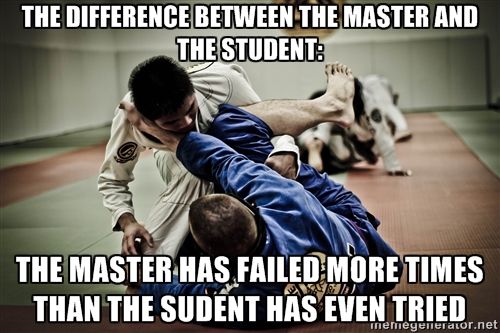
If failure builds skill, then I should be an expert at a ton of stuff. The problem with this theory is that failure doesn’t by default make someone better. You have to want to be better, evaluate your shortcomings, and find a way to do it differently next time. Then go and actually do it. Failure is an effective teacher only when the student doesn’t stop trying.

Regular readers of my blog know that I am an very devoted amateur radio hobbyist and work professionally in the communications electronics field. I’ve spent this summer doing a lot of upgrades to my equipment and more than once I’ve been made painfully aware that for all the skill and expertise I’ve collected over many years of working on electronics as both a hobbyist and a professional, there is always something new tripping me up. Even more humbling is when I make mistakes performing easy tasks that I’ve successfully done before with barely a thought but at the moment cannot seem to grasp.

Someone who is admired and respected for their skill in a particular area make it look so easy, yet behind every flawless performance lies thousands of mistakes no one ever sees. Olympic athletes spend years falling down, missing the shot, not making their time, pushing through injury and illness. They take it all in and do better next time, until “next time” is the one single now-or-never Olympic event that is the denouement of their life’s effort.

On a far less Olympian but equally meaningful plane, there are everyday folks working as carpenters, auto mechanics, electricians, musicians, and teachers who are experts in their field and work largely unnoticed. After all, they don’t give gold medals for being the best accountant. The work may not be glamorous but it is important; the world runs better because these people did not quit the first time they failed at what they are now masters of.

failure

Every now and then I am invited to give a public talk about the technical aspects of solar energy and how it can be applied to everyday life. I always bring along some of my equipment for a live demonstration of how it all works. My solar power station attracts a lot of interest and many flattering compliments. The system is a point of pride for me because I designed and built everything myself from the ground up. I want all my electronic projects to say, “the person who made this is a highly skilled craftsman who cares about his work”.  A master does not brag about how good he is. He lets his results speak for him.

What the audience does not see behind me is is the decades-long trail of failure littered with burned out components, incorrectly wired circuits, blown fuses, ruined electrical connectors, a discharged fire extinguisher used on one of my alleged brilliant ideas, and spending hundreds of evenings and weekends in a college engineering lab doing it over and over and over until I had it right. I’m no genius. Usually I was the last to leave the lab because I was the slowest to figure it out. But I did figure it out.

For those who are driven to be accomplished at something, failure to keep trying is worse than failure at the task itself. Nobody wins all of the time. Show me someone who claims to have never been a failure and I’ll show you someone who has also never succeeded, or is a liar. The world rightly places a high value on success and winning, yet there is little talk of all the failure and pain and sacrifice that is the unavoidable price of being a master.

We live in a society that wants reward without risk, recognition without sacrifice, and no hurt feelings. The reality of life is indifferent to what society wants, or perceives as success, or how artificially low the bar is set to create as many winners as possible: Everyone knows which kids showed up early for practice every time, gave it all they had, and really earned the trophy, and which kids just can’t cut it and are being pandered to for the sake of appearances. Whether it’s winning an Olympic gold medal, beautifully playing a musical instrument, or expertly troubleshooting a complex electronic circuit, the hand of the master is guided by wisdom gained from the humiliation of uncountable failure.

This Land Is My Land

By: Chris Warren

Maybe it’s the wide open skies, or the view that goes for endless miles, but I get a sense of freedom being out in the country. The sweetest moments are when I cannot see any man made object, not even a jet trail in the sky, or hear any man made noise. I marvel at it all and hear a voice that says “God exists.” It’s a complete peace, a greatness, that no city or human-based creation can replicate.

The other day I was on a road trip that took me through north central Illinois. I’ve made this trip dozens of times before and I never find myself in a state of bored repetitiveness. Sitting on the tailgate of my truck sipping a cold soda I had a perfect view of cornfields meeting a clear blue sky that literally stretched as far as I could see. As if on cue, a bird started singing. I look over my shoulder to spot a cardinal (which is the state bird of Illinois, by the way). It was greatness in the voice of a little bird.

Any place that you can hear only natural sounds is a good place. My own backyard qualifies, most of the time, depending on which way the wind is blowing and how busy the railroad is. When I visit the big city, the thing I notice the most is the noise. In the city there is never a moment when I cannot hear some form of man made noise.

greatness
Driver’s seat view from my pickup truck rolling through northern Illinois, July 21, 2015

I first came to appreciate the greatness of the natural world years ago when I discovered motorcycles. I was looking for a place to rip through turns and charge up hills and run free for hours without the inconvenience of traffic congestion. Not being encapsulated in a car meant I could smell the trees and the muddy rivers, and yes even the cows. I could feel the subtle temperature changes when I rolled through a shaded grove. I found myself purposely stopping in the middle of nowhere and shutting the engine off just to meditate on the greatness of nature without man’s interference.

Nature taught me about its majesty by tempting me to stop and pay attention to it, which is actually not very hard when the man made distractions are gone. From the fields and birds mere feet away to the wind and lightning and stars and the planets in the night sky, nature has much to tell. Through some cosmic twist of irony, the natural world says the most about itself during the quietest moments. For all the greatness of the earth I’ve been lucky enough to see for myself, there is so much more out there I have not seen. Spending a few hours zipping through the Midwest is cool for what it is, but the United States also has mountains and valleys and oceans, all of which have their own unique lessons to teach.

A few years ago I went on another road trip to visit a friend in Florida, and that of course means hitting the beach! He did not take me to the touristy beach where there are so many people and blankets that you can barely see the sand; he instead took me to the Gulf Islands National Seashore. Most of the place is not accessible by car. We trudged for over half an hour, through the sand and Florida heat, dragging our stuff with us. We plopped down in a spot where we could not see a single person both ways up the shore. But for some tall buildings in the distance and the occasional boat going by, I could have been fooled into thinking we were shipwrecked on an island. We brought our iPhones to play some music, but we never used them. The sound of the waves gently rolling in and the caw of the gulls was too perfect to be marred by digital cacophony.

Most people live in or near a large city, and while there is nothing wrong with that, the city makes it too easy to become detached from what the world would be like if humans were not constantly messing with it. I like convenient shopping and quick pizza delivery as much as anyone, but being away from it does a lot for me too. The country is nature’s way of saying it does not need tall buildings and impressive boulevards to achieve greatness. It gives me a feeling of appreciation for God’s wonder, the perfect plan of His creation, and patriotism for a mighty nation that has given me more than what can be contained within its vast borders. The land stretches out before me for more miles than my truck will ever reach and speaks of His greatness without using a single word.

tomorrow

Set Yourself Up For Tomorrow, Today.

By: Chris Warren.

I consider myself an average person with average problems. Some days are great, most are good, and thankfully only a few are miserable. No matter what goes down in my fairly busy life, there is always one constant: Tomorrow will be another chance to try again.

Everyone has had a bad day but no one has ever had a bad tomorrow. And that is the beauty of a new day. Much pithy wisdom has been produced about tomorrow. In truth, it’s a complete unknown and nobody really knows what it will be filled with. When I wake up in the morning, all I know for sure is I’m not dead. Everything after that is an upgrade. When tomorrow becomes now, I owe it to myself and everyone around me to make the best of it.

When I wake up in the morning, all I know for sure is I’m not dead. Everything after that is an upgrade.

Years ago my parents had a neighbor who had a very well paying job, a nice house, and a circle of good natured friends. He was affable and got along with everyone. Then he abruptly quit his job and started avoiding people. He spent most of his days sitting alone in his yard smoking and drinking beer. He neglected his property. His friends stopped coming around. He would do passive-aggressive things to irritate the neighbors such as leave the radio playing loudly out an open window while he was gone all afternoon; this behavior escalated to the point that the police got involved. What was this dude’s problem? Alcoholism? Mental illness? Just stopped giving a damn? He sold his house and was last seen leaving town in a junky old truck pulling a small travel trailer. I’m guessing whatever he’s doing now, assuming he’s even still alive, involves a lot of beer and cigarettes.

I never woke up in a worse mood than when I went to bed the night before. Part of the appeal of tomorrow is that you have to sleep a little before you get there, and the physiological effect of rest goes a long way in recalibrating our psyches. Setting yourself up for a positive day means deciding that the hours that lay before you are a choice. It’s true that we usually don’t have complete control over what we do with those hours, but we do have control over how to react to them.

Attitudes are a lot easier to control than situations. If you decide now that tomorrow will suck, then there is a 100% chance that it will. At some point my parents’ neighbor decided that it was easier to accept a mediocre today than put any effort into a better tomorrow. I believe he was neither mentally ill nor an alcoholic. There was nothing deep going on with this guy. He just was a bitter, pissed off, lazy old man who gave up on his tomorrow.

My best and closest friend has spent the last two years trying to get out of a demoralizing, low-paying job in a cable TV company call center: Applying for dozens of other positions, going on interviews, and chasing leads. All of it turned out to be dead ends. We talk at least a few times a week and during this whole time never once did I sense he was feeling sorry for himself or letting go of his confidence that there was something else out there, maybe tomorrow. Finally, he got a job offer that was better than expected! He starts next week. He never gave up on his tomorrow.

Every night before lights out, I pause for a moment and contemplate the previous day. What did I do right? What do I regret? What can I carry forward to make tomorrow better, and what bad habits need to go? What must I do to avoid becoming that bitter, pissed off, lazy old man? In the morning the cycle begins anew: When the future becomes now, the attitude we have in the reality of today will determine how we handle…tomorrow.

truth

Fencing In The Truth.

By: Chris Warren.

After a week of partisan screeching from both ends over two huge Supreme Court cases, a foreign trade deal, and a 150 year-plus cyclic hostility towards a flag, I’m ready to wish I was in a coma for the last few days. The headache is not from the nature of the issues, but from each faction insisting they are on the side of truth and the other is pulling off a great deception. I do believe there is a line where truth ends and lies begin, with a caveat that the specific boundaries are not easily determined by us mortals. Of course, mortals will always try anyway and fail. The failure comes out of the theory that for “my” side to be right, “your” side has to be wrong.

Although I do not consider myself a neutral bystander to any of these issues, I’m not so hardened to a view that I can’t admit those with whom I disagree have a point worth taking seriously. My boundary of truth is like one of those temporary fences used around constructions sites: Sturdy enough to maintain separation, flexible enough to be moved when needed, and is easily repaired when it gets plowed down.

There are absolutists who will shudder at my movable fence theory and accuse me of moral relativism. Naturally, their morals are the correct ones and everyone else, including me, is venturing down an evil path. It’s funny how easily they can identify everyone else’s inconsistencies while being completely if not willfully ignorant of their own. Whether it’s preaching about family values while hoping no one finds out about their own genetically-related dirt, or globe trotting aboard a carbon-puking private jet to get paid six figures giving speeches about how all the rest of us are earth killing slobs and puppets of the rich, they never fail to show us how problematic moral absolutes can be when one epically collides with a thick concrete wall of their own making.

https://www.youtube.com/watch?v=BgD04J7e4aQ&spfreload=10

Simply ignoring the self-appointed truth police is not enough of a defense. The pablum is too thick to plug one’s ears and hope for the best. The most effective and perhaps only defense is one’s own truth. That means clearly thinking through your beliefs and knowing how you arrived at them. It means admitting when an idea is wrong and discarding it instead of clinging to contorted rationalizations for keeping it.

More than all else it means not lifting yourself up by putting others down. It seems we live in a time when it’s not enough to be “right”. We must also beat down all who don’t go along. Almost everyone has at least one acquaintance who is on social media numerous times a day posting provocative articles and memes about controversial topics. Notice how nearly all of these nuggets of what they consider “truth” do not directly support their cause…they instead take cheap shots at the opposing cause. They are miniature versions of the larger media world. I find myself quickly clicking away from web pages and changing channels. I don’t necessarily disagree with what they are saying; I just don’t like the way they are saying it.

The default is to blame the internet and electronic media for the truth wars, but I’m not willing to go there. It’s too easy. The media as a communications mode is amoral, without  any inherent bias. People will be who they are; the internet just gives them a greater opportunity to make fools of themselves. Neither side of any issue should have to be the only one expected to move his fence to accommodate the other. For too many, the boundaries of truth are hopelessly cemented in the ground.


sir nicholas winton

Sir Nicholas Winton 1909-2015.

Sir Nicholas Winton, a British citizen who during World War II singlehandedly rescued hundreds of Jewish children from what would have been certain death at the hand of Adolph Hitler and the Nazis, died on July 1, 2015 at the age of 106.

Winton had three biological children; the Jews he saved “adopted” him as their own. Many of these survivors now have grandchildren and great grandchildren of their own, all of whom would not be here but for Winton’s intervention. His influence literally transcends generations.

Although he’s been the topic of many books and television programs and was decorated by the British Crown, almost nothing can justly explain Nicholas Winton’s selfless humanitarianism.

Sir Nicholas Winton was the topic of this January 17, 2015 Twenty First Summer article and I urge anyone who may have missed it the first time to read it now and get a small insight as to who Winton was. He is a person everyone should know about.

I am confident that there are others like Winton living today, anonymously doing what they know is right even at great risk to their own safety. The Nazis have been vanquished but there are other factions out there just as bad and in many ways worse. We will never be able to stomp all of them out completely, but we can follow Winton’s example, push back in every way we can, and support those who do the kind of work most of the rest of us don’t have the courage to take on ourselves.

When I wrote my original article back in January, I knew that due to Winton’s age it was only a matter of a short time before I would have to follow up with this tribute. I was not expecting it to be a matter of months. This is a horrible loss.

Twenty First Summer mourns the death of Sir Nicholas Winton and extends its deepest sympathy to his “real” and “adopted” family.

gratitude

Fifteen Square Inches Of Gratitude.

By: Chris Warren

On the way in from work I stopped my motorcycle at the mailbox to grab whatever crap the Postal Service is supporting itself with these days. At least 90% of the mail I get I would not know the difference if it never arrived. The other 10% is a bill or something that will evolve into a lot of hassles if I blow it off. The mail seldom brings lasting gratitude; today was the rare exception.

Mixed into this otherwise typically disappointing delivery was a small envelope. I knew right away what it was. My “adopted” nephew James, whom I have written about before in this blog, sent a thank you card for the high school graduation gift I gave him. I was getting a good vibe before I even opened it. I really care about this kid and since he was born I have not passed on a chance to let him know it.

Let’s be honest: When it comes to gratitude, we can’t expect too much from guys his age. It’s just part of being eighteen. It’s not an excuse or a defense; I’m only saying that I understand the mindset. Back in my young days I wasn’t exactly gushing with appreciation for all the things my elders did for me either. That I received an actual physical card at all puts James well ahead of my formerly adolescent self.

James fulfilled his portion of a basic personal courtesy. Had it ended there I would have been completely satisfied, but he also included a lengthy handwritten note of gratitude to me for always being there for him. He filled up almost the whole inside of the small card telling me how cool I was and how much I meant to him. I always knew he respected and looked up to me but had never seen it in his own words; moments like this are my reward for giving a damn.

People who are true of heart do not do nice things for others with the expectation of bringing attention to themselves. In other words, if all you’re looking for is adulation for a good deed, then maybe you are doing the good deed for the wrong reasons. At the same time, no one wants to go totally unnoticed either.

Gratitude is the mechanism used to resolve this conflict. Most people expect to be thanked as a matter of social convention. I don’t see it that way and I know I’m in the minority. Gifts and favors are (supposed to be) a freewill gesture, so too is being grateful for them. I’ll thank those who are good to me but I’m not offended when someone does not send a written thank you for something I’ve done for them, even though I’m extra happy when they do. I already have the warm feeling of knowing I did a good deed. Anything beyond that is a bonus. Being kind to others has no net negative.

That brings me back to the simple lesson in James’ card. My thank you is knowing I played a small part in helping him become an amazing person. His putting it in writing was the bonus. I’m going to keep that card always because it reflects the sentiments of a young kid who thinks of me as a favorite uncle. I didn’t need to be told where I stand with James, nor did he need to say anything out of some concern that I was unaware of what he thought about me. The beauty of this transaction is that gratitude turns a good deed into a two way street, and that’s more than good enough for me.