
by Chris Warren
A lost culture.
When something that is so ingrained into our lives that we hardly even thought about it transforms into an unrecognizable phantom, the loss is hard to explain. It was not an abrupt conversion. We just didn’t notice, until one day, suddenly, we did. It takes one by surprise, but it shouldn’t have. The decline of AM radio has cultural and social implications that are not yet fully realized, but the direction has been clear for at least thirty years. For generations, AM radio was a ubiquitous component of the American experience. Today it is on the cusp of becoming nostalgia.
The radio reminds me of my home far away…
When I was a kid, my family would often spend summer vacations in Hayward, Wisconsin. The resort we stayed at was a day’s drive from our home in Illinois. We did not have smartphones or game systems or anything like that. We didn’t even have FM radio or cassettes! My dad’s 1972 Chevrolet Kingswood station wagon had a basic AM radio, with the mechanical push-button presets. Dad would have to search for a new station every ten or twenty miles because, rolling through rural Wisconsin, that’s all the podunk town little AM radio stations were good for. Each station was staffed by live announcers and had its own unique sound.
Country music was the predominant format. We didn’t care. We didn’t even care when the AM signal was scratchy and static-y. It didn’t matter when the signal completely dropped out every time we drove under a bridge. That was part of the charm. The clarity of modern digital music is certainly a technical improvement, but it is almost too clean. A few imperfections remind us that we’re still human.
There was a tabletop AM radio in our cabin at the lake. There was one, maybe two stations we could pull in. And yes, it was country music. To this day, every time I hear a Charley Pride or Ronnie Milsap or John Denver song, I think of those fun childhood times in Hayward. Something about the impurity of the audio, the friendly chatter of the announcer, who was a real person located not too far away, made it a memorable experience. I don’t believe the memory would be the same had we simply streamed the same songs to a Bluetooth speaker. I might not have remembered it at all.
Part of the family.
The radio on top of the refrigerator in my parents’ house was always on WLS AM-890. Every morning they had a feature called Animal Stories. It was a short eight- or ten-minute bit that related funny and outrageous true stories about pets and wildlife. Right after Animal Stories, Mom would shoo us off to school. Animal Stories became something of a ritual in our house, and even as we kids got older, we didn’t outgrow it. Animal Stories was so legendary that years later, long after it left the airwaves, WLS released the entire series on compact discs. I bought the set and my family got a lot of laughs revisiting an old favorite. You can still find Animal Stories on YouTube.
Even better than Animal Stories was school closing due to snow. It excited high school seniors all the way down to kindergarteners. Back then, snow closings were quite rare because we were not coddled little sissies, so when school was cancelled it was truly a treat! We had to sit patiently and listen to WBBM AM-780 while announcers read school closings one by one. As soon as our district came up there were cheers and smiles all around. Well, from the kids anyway. The parents felt otherwise.
Today it seems school districts will cancel classes for the flimsiest of reasons, and of course no one waits beside a radio for snow day announcements. Closings come via text message and the internet. The anxiety and anticipation building up to that joyful moment are gone, replaced by a sterile, efficient data stream. No kid today stares at a cellphone screen waiting with angst the way we clung to the radio.
Rock and roll rescue, via the transistor.
In the mid-1950s home television use accelerated and most of the radio dramas and comedies common up to then transitioned to TV. A shift like that might have made AM radio irrelevant, but two new developments around the same time as television, one cultural and one technological, may have “rescued” AM radio: Rock and roll music and the transistor.
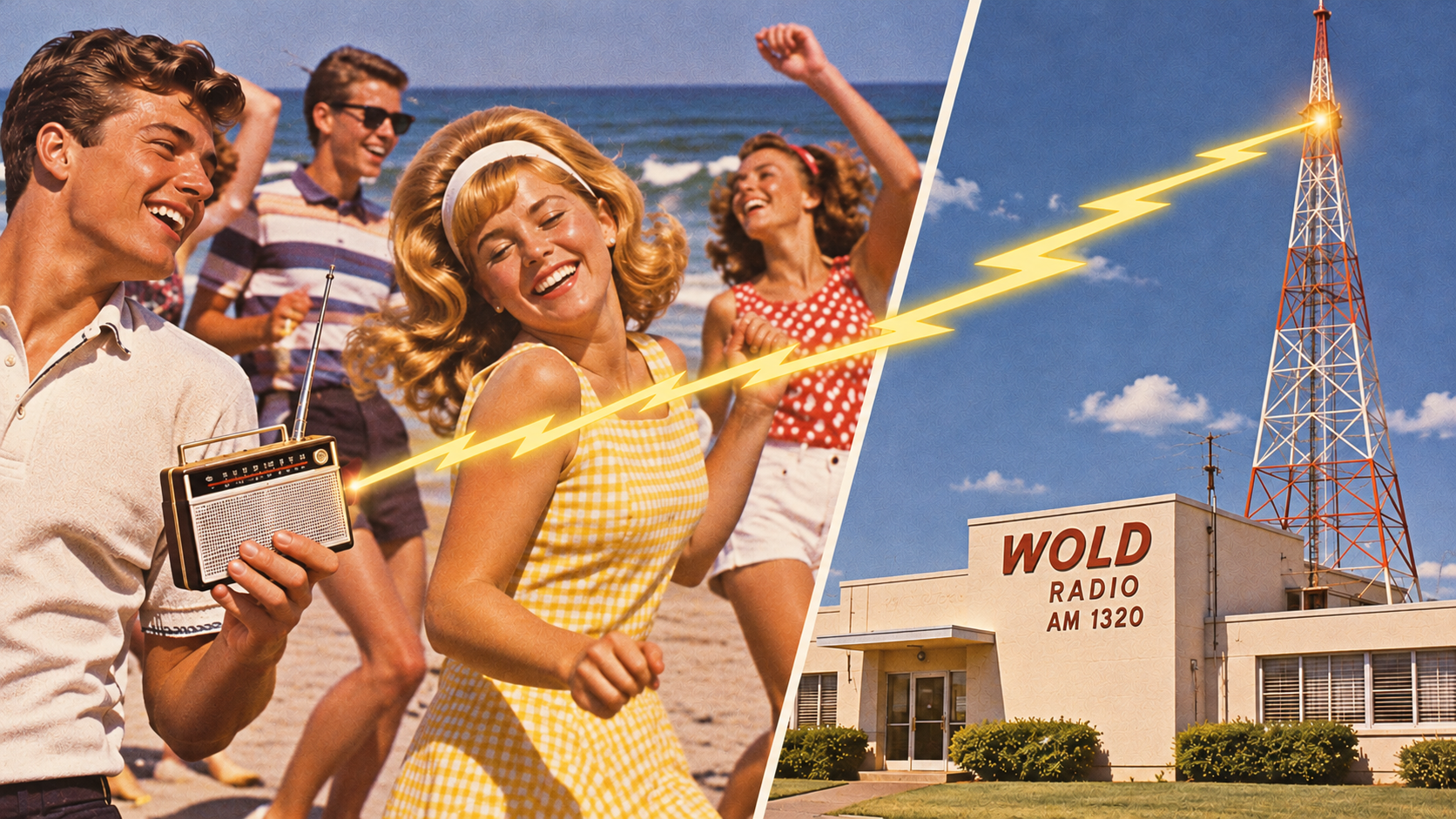
Rock and roll was a huge sensation with teenagers. But record players were stationary, and while portable vacuum tube radios existed, they were “portable” in name only and had limited usefulness. Then the transistor came along. This revolutionary device replaced physically delicate and power-hungry tubes, making radios smaller, lighter, and much more energy efficient. By the 1960s, engineering advances brought the cost of transistor radios down to a point where even teenagers were running around with them. Transistor radios were truly the “smartphone” of their day: they were trendy, cool, actually portable, and everybody wanted one.
Transistor radios allowed young people to detach from their home and parents and take rock and roll with them. Much like the automobile, the transistor radio represented a pathway to freedom and independence.
For the first time ever, no kid had to be tied down at home to a radio that was essentially furniture and consumed a lot of power. Many radio personalities became celebrities; when they made personal appearances, hundreds and sometimes thousands of teenaged fans would attend. Kids brought their radios to friends’ houses or the beach; teens would gather on weekends for impromptu dance parties. It culminated in excitement and music and fun, melded together by AM radio and crammed into a little box of electronics one could carry anywhere. It’s hard to see how all this would happen without rock and roll, AM radio, and the transistor.
Lost to time, but still in our hearts.
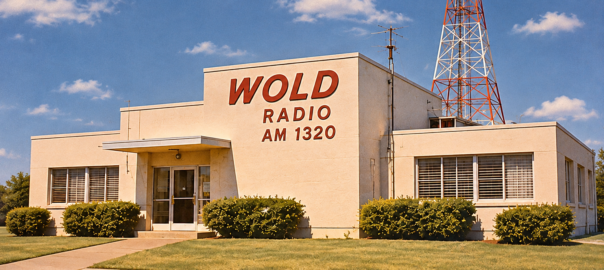
In its heyday, AM radio stations, especially in small towns, were often locally owned family businesses that fostered a sense of community. They broadcast birth, death, and marriage announcements, crop and farm reports, high school sports, civic events, church services, and more. In between, they played popular music. The announcers were local citizens, your neighbors, people you might personally know. AM radio was woven into the vibe of the town. That all changed with the Telecommunications Act of 1996, when large media conglomerates started buying up stations. Local programming was replaced with homogeneous, corporatized content produced in a distant place.
Today, one can tune around the AM dial and hear the same program on several frequencies. Listen long enough, and you’ll notice there are few if any references to local people, places, or events. A handful of big city stations still have locally produced programming, but the most common format elsewhere is just canned content. Many AM radio stations have zero –zero!– programs originating from the areas they serve.
The days of singing along to Ronnie Milsap on a scratchy AM radio signal are long behind me. While I certainly enjoy streaming whatever clear digital content I want anytime I want it, I’m not hopeful future generations will know the simple joy of listening to a crackling signal where a live, local announcer talks about familiar and relatable things.
AM radio is on a well-worn path toward being a historical curiosity much like steam locomotives and sailing ships are now. My generation is probably the last to experience that sometimes-fuzzy analog voice reaching out to make a personal connection and participate in our everyday lives, a warm feeling media conglomerates and the internet can’t seem to replicate. Some of us remember what that “phantom” used to be.