All posts by Chris Warren

AM RADIO

For Those Who Lived It, the Phantom’s Signal Never Fades.

by Chris Warren

A lost culture.

When something that is so ingrained into our lives that we hardly even thought about it transforms into an unrecognizable phantom, the loss is hard to explain. It was not an abrupt conversion. We just didn’t notice, until one day, suddenly, we did. It takes one by surprise, but it shouldn’t have. The decline of AM radio has cultural and social implications that are not yet fully realized, but the direction has been clear for at least thirty years. For generations, AM radio was a ubiquitous component of the American experience. Today it is on the cusp of becoming nostalgia.

The radio reminds me of my home far away…

When I was a kid, my family would often spend summer vacations in Hayward, Wisconsin. The resort we stayed at was a day’s drive from our home in Illinois. We did not have smartphones or game systems or anything like that. We didn’t even have FM radio or cassettes! My dad’s 1972 Chevrolet Kingswood station wagon had a basic AM radio, with the mechanical push-button presets. Dad would have to search for a new station every ten or twenty miles because, rolling through rural Wisconsin, that’s all the podunk town little AM radio stations were good for. Each station was staffed by live announcers and had its own unique sound.

Country music was the predominant format. We didn’t care. We didn’t even care when the AM signal was scratchy and static-y. It didn’t matter when the signal completely dropped out every time we drove under a bridge. That was part of the charm. The clarity of modern digital music is certainly a technical improvement, but it is almost too clean. A few imperfections remind us that we’re still human.

There was a tabletop AM radio in our cabin at the lake. There was one, maybe two stations we could pull in. And yes, it was country music. To this day, every time I hear a Charley Pride or Ronnie Milsap or John Denver song, I think of those fun childhood times in Hayward. Something about the impurity of the audio, the friendly chatter of the announcer, who was a real person located not too far away, made it a memorable experience. I don’t believe the memory would be the same had we simply streamed the same songs to a Bluetooth speaker. I might not have remembered it at all.

Part of the family.

The radio on top of the refrigerator in my parents’ house was always on WLS AM-890. Every morning they had a feature called Animal Stories. It was a short eight- or ten-minute bit that related funny and outrageous true stories about pets and wildlife. Right after Animal Stories, Mom would shoo us off to school. Animal Stories became something of a ritual in our house, and even as we kids got older, we didn’t outgrow it. Animal Stories was so legendary that years later, long after it left the airwaves, WLS released the entire series on compact discs. I bought the set and my family got a lot of laughs revisiting an old favorite. You can still find Animal Stories on YouTube.

Even better than Animal Stories was school closing due to snow. It excited high school seniors all the way down to kindergarteners. Back then, snow closings were quite rare because we were not coddled little sissies, so when school was cancelled it was truly a treat! We had to sit patiently and listen to WBBM AM-780 while announcers read school closings one by one. As soon as our district came up there were cheers and smiles all around. Well, from the kids anyway. The parents felt otherwise.

Today it seems school districts will cancel classes for the flimsiest of reasons, and of course no one waits beside a radio for snow day announcements. Closings come via text message and the internet. The anxiety and anticipation building up to that joyful moment are gone, replaced by a sterile, efficient data stream. No kid today stares at a cellphone screen waiting with angst the way we clung to the radio.

Rock and roll rescue, via the transistor.

In the mid-1950s home television use accelerated and most of the radio dramas and comedies common up to then transitioned to TV.  A shift like that might have made AM radio irrelevant, but two new developments around the same time as television, one cultural and one technological, may have “rescued” AM radio: Rock and roll music and the transistor.

Rock and roll was a huge sensation with teenagers. But record players were stationary, and while portable vacuum tube radios existed, they were “portable” in name only and had limited usefulness. Then the transistor came along. This revolutionary device replaced physically delicate and power-hungry tubes, making radios smaller, lighter, and much more energy efficient. By the 1960s, engineering advances brought the cost of transistor radios down to a point where even teenagers were running around with them. Transistor radios were truly the “smartphone” of their day: they were trendy, cool, actually portable, and everybody wanted one.

Transistor radios allowed young people to detach from their home and parents and take rock and roll with them. Much like the automobile, the transistor radio represented a pathway to freedom and independence.

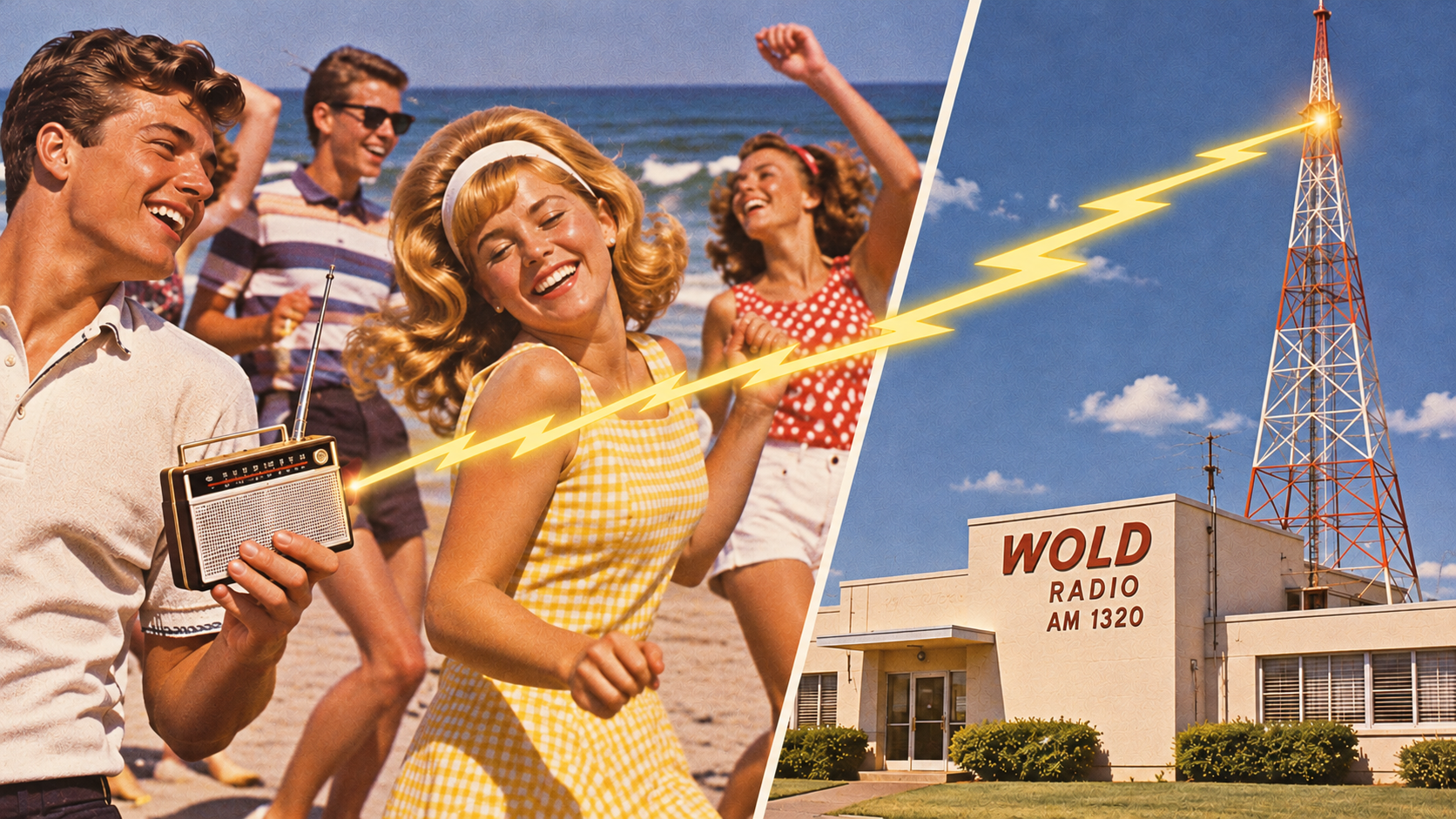
For the first time ever, no kid had to be tied down at home to a radio that was essentially furniture and consumed a lot of power. Many radio personalities became celebrities; when they made personal appearances, hundreds and sometimes thousands of teenaged fans would attend. Kids brought their radios to friends’ houses or the beach; teens would gather on weekends for impromptu dance parties. It culminated in excitement and music and fun, melded together by AM radio and crammed into a little box of electronics one could carry anywhere. It’s hard to see how all this would happen without rock and roll, AM radio, and the transistor.
AM RADIO
AI IMAGE
Lost to time, but still in our hearts.

In its heyday, AM radio stations, especially in small towns, were often locally owned family businesses that fostered a sense of community. They broadcast birth, death, and marriage announcements, crop and farm reports, high school sports, civic events, church services, and more. In between, they played popular music. The announcers were local citizens, your neighbors, people you might personally know. AM radio was woven into the vibe of the town. That all changed with the Telecommunications Act of 1996, when large media conglomerates started buying up stations. Local programming was replaced with homogeneous, corporatized content produced in a distant place.

Today, one can tune around the AM dial and hear the same program on several frequencies. Listen long enough, and you’ll notice there are few if any references to local people, places, or events. A handful of big city stations still have locally produced programming, but the most common format elsewhere is just canned content. Many AM radio stations have zero –zero!– programs originating from the areas they serve.

The days of singing along to Ronnie Milsap on a scratchy AM radio signal are long behind me. While I certainly enjoy streaming whatever clear digital content I want anytime I want it, I’m not hopeful future generations will know the simple joy of listening to a crackling signal where a live, local announcer talks about familiar and relatable things.

AM radio is on a well-worn path toward being a historical curiosity much like steam locomotives and sailing ships are now. My generation is probably the last to experience that sometimes-fuzzy analog voice reaching out to make a personal connection and participate in our everyday lives, a warm feeling media conglomerates and the internet can’t seem to replicate. Some of us remember what that “phantom” used to be.
serving others

The Shoe Box Epiphany

by Chris Warren.

What comes around goes around.

Serving others by definition requires effort or sacrifice. But what happens when the tables are turned? What happens when the server unintentionally becomes the served? The server comes away from the experience with an unplanned and unexpected level of awareness. They may gain a deeper insight or experience personal growth. The maxim “you always find good things when you’re not looking for them” endures because it’s been proven true over and over. Serving others opens the door to discovering an attribute in oneself that previously went unnoticed. Or to put it more simply, they got more out of it than they put in.

An ersatz “shoe salesman.”

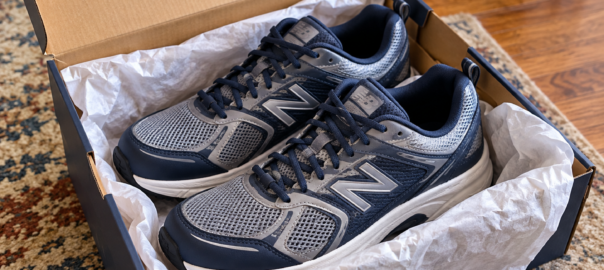
I was kneeling on the floor, surrounded by boxes of shoes. My job was to find the proper size and style from the wall of shoe boxes before us. Then, open the boxes, remove the tissue from the shoes, and present them to my dad so he could try them on. Finally, pack up the rejects and return them to the shelf. Repeat as needed until we find something that works for him.

My dad is elderly. He functions quite well, but for some tasks he needs help from one of us kids. This usually comes in the form of driving him anywhere he’s not comfortable going alone, managing his money, and arranging medical appointments. Then there are situations he doesn’t technically need help with but go more smoothly and are less stressful if someone is there to shepherd the process along. This shoe-shopping expedition fell into that category.

Ever since my mom died, dad has felt lost and isolated. I’ve done my best to keep him busy, even if it’s just to invite him to ride along while I care for my personal errands. My parents were very happily married for 63 years and devoted themselves to family and serving others. For his entire life dad ate healthy, remained physically active, was never overweight, never smoked, and took care of himself. Even now he still walks the dog daily and does yard work. At age 87, the reward for that effort is he’s in pretty damn good shape.

SERVING OTHERS
IMAGE CREATED BY ARTIFICIAL INTELLIGENCE FOR TWENTY FIRST SUMMER.
The curse of the last man standing.

But while observing dad over the last few years of my mom’s extended illness and ultimate death, a subtle reality came to me: being the “last man standing” is a lonely reward. His peer group is very small and getting smaller. He goes out for lunch with some former coworkers once or twice a month. Over fifty people used to attend; now it’s down to a dozen or so. Dad has an old car that he wrenches on himself. He’s been friends with two other “old car guys” for over twenty years. Now one of them has cancer; some days he’s too fatigued to chase hobbies. The other has a wife in a nursing home who absorbs most of his time and attention. Dad outliving my mom and both his younger brothers only closes the ring tighter.

You don’t find too many guys pushing up close to ninety years old, still in their own home, and for the most part active and living independently. It seems every few months he receives word that someone he knows has died. Those death notifications arrive a lot more often than they used to. Dad states, partly as a joke and partly as a dark acknowledgment, that everyone he knows is either in the cemetery or the nursing home.

My dad has both a sense of humor and a lot of wisdom born of experience. When he makes cracks like that, one cannot tell if he’s just joking or if he’s making a genuine life observation. He’s certainly aware he’s old and the last of his generation. And he’s often stated that he knows his time left in this life is not long. My mom used to do the same thing. As a comparatively younger person, that’s hard for me to understand.

Yesterday’s barbecue is today’s memorial.

There is a photo in my parents’ house of a Fourth of July barbecue from a generation ago. The photo was taken at my parents’ house, the same one my dad still lives in alone. There are about two dozen people, starting on the front porch, spilling down the steps and into the yard. Pretty much everyone my parents knew was invited to the party: relatives, neighbors, coworkers, friends. I’m in that picture, much younger. But as I stop in the stairway and look at it again in 2026, it’s not a great feeling to realize over half the people in that photo on that festive day are dead.

The picture has become a memorial to all those whom my dad has outlived. At this point he is the oldest person in the family. That’s a position I don’t think he ever anticipated having, and for him I don’t think it’s a point of pride. But that is the reality and dad is adept at accepting uncomfortable realities, albeit reluctantly. I think when people reach an advanced age and know they’ve lived well and contributed something meaningful to the world, something clicks on in their psyche that makes them peacefully immune to fear of their mortality.

This purchase doesn’t involve money.

Right there, kneeling on the floor in the shoe aisle, my consciousness suddenly popped into focus. Before me was a man who, in the distant past as the father of a young son, would be the one helping me select a pair of shoes. Now, to use a pun and a metaphor, the shoe is on the other foot. Assisting dad with a mundane, everyday task made me understand I was getting much more out of the situation than he. I’m not exactly a young man myself, yet my own life experience, which itself is substantial, still leaves plenty of room to learn and grow.

Serving others should not be a chore or a drudgery. That doesn’t mean it’s never hard, nor inconvenient, nor undesirable. What it does mean is that it should be approached in the spirit of goodwill, selflessness, and kindness. It’s something done even when outwardly there is nothing in it for you. But if you contemplate beyond the immediate task, you’ll discover there is quite a bit in it for you. Contributing to a greater good with no expectation of compensation other than gratitude for the opportunity to serve reveals a beautiful soul. Even something as pedestrian as shopping for shoes can achieve this result. I kept bringing dad shoes until he found a pair that he liked because the moment called on me to be a humble shoe salesman, and it was not a business transaction.

fall

The Quiet Crawl of Fall.

By Chris Warren

Mother Nature’s tease.

There are just a few days left in September. Summer officially ended on either August 31 or September 22, depending on what standard one uses. Regardless of technicalities, in the Great Lakes state where I live, that means any weather that could plausibly be classified as “summer” is rapidly diminishing. We may hit an occasional hot day between now and Halloween, but that’s just a tease. Fall is a subtle spirit that quietly crawls into our lives; for those who love summer it is a part of the cycle of hope and patience.

Daylight is fading.

Fall is a mercurial season to us upper Midwesterners because it randomly flips between warm and cool, wet and dry. It’s a time of the year when one might need to use the furnace and air conditioner on the same day. The trees are still green but a few leaves begin to trickle down. Little by little, almost imperceptibly, the signs accelerate. I have to carefully monitor the weather in advance if I want to ride my motorcycle. One cannot just assume it’s going to be warm and dry.

Many of us who thrive in the heat and extra hours of daylight are foolishly rationalizing that it’s not over yet even as the sun sets a little sooner each evening, rises a little later each morning, and “shorts and T-shirt” weather turns into “jeans and hoodie” weather.

The cognitive dissonance I must inflict on myself to accept the meteorologic reality happening outside my wishful-thinking brain is breathtaking. Then one morning, any delusions I was clinging to about “we still have some summer left” are busted. The dew that used to form overnight is now frost. In less than thirty days, by the middle of October, The Quiet Crawl has ended. Fall has indisputably arrived full force and even the most optimistic summer-worshippers must concede.

The psychiatry of the seasons.

Fall is the most schizophrenic season. Constantly flipping through weather extremes, like an untreated psychiatric patient it never gets better, only worse. It’s never certain what you’ll get; summer-lovers only know every day will be lesser than the last. Spring is schizophrenic too, but in the case of Spring each day progressively improves. Yes, there will be days that feel like a step back into January, but we know the end of spring will be better than the beginning. Fall affords us no such comfort. For their part, Summer and Winter are neutral. There’s not a lot of variation and you know what to expect. But Fall is terminal decline. The weather gets colder and darker until it becomes a full-blown case of Winter.

fall
IMAGE CREATED BY ARTIFICIAL INTELLIGENCE FOR TWENTY FIRST SUMMER.
Fall plants seeds of gratitude.

Even as much as I hate to see summer pass, fall does serve an important purpose: It makes me grateful for summer. Isn’t it a natural feeling to appreciate more that which we cannot have all the time? Spring is the default season of renewal and planting, but from where I sit as one who loves summer, the real season of renewal is fall. The disappointment of fall forces me to reflect on the previous summer and plant hope that next summer will be fulfilling and positive. Although the fulfillment is delayed, it is the catalyst forcing me to better appreciate what I can’t always have.

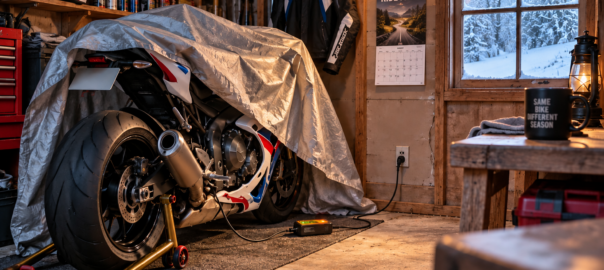
In the next week or two I will prepare my motorcycles for a long winter pause and roll them into storage; throwing a tarp over them will probably be the last I see of them until spring. I’ve been doing this ritual every year for the last forty years. That day is never a good day for me. But my hope, and what encourages me, is the converse of that day: another ritual I’ve also performed annually for forty years.

That other ritual arrives every spring, usually around mid-March. I pull the tarps off and check over my motorcycles to make sure they are mechanically good to go. Then comes the moment I’ve waited months over the winter for: Roll them out of hibernation, hit the start button and feel a rush of awesome wash over me when the engines pop to life. I slip on my helmet, which has also been lonely and idle for months. Then I disappear down the road on my two wheels of pure joy, appreciating it more because The Quiet Crawl of Fall, only temporarily, took it away from me.

artificial intelligence

Artificial Intelligence: Keep Cranking.

By Chris Warren.

If you can’t say anything nice…

Artificial intelligence, rightly, gets a bad rap. It’s true: it has displaced people from their jobs, made bad decisions that a human would not have made, created vast violations of privacy, and consumes a lot of energy and resources. It barely existed until recently, and it’s upending our lives. Even with all that, I have to admit artificial intelligence is a net benefit to society. When the good is balanced with the bad, the good wins. But my recent experiences with artificial intelligence have me questioning the “intelligence” part.

You often miss your own mistakes.

I do a lot of writing for another website. It keeps me quite busy; that’s why this website is so seldom updated. The thing is, every writer needs a copy editor. That person should not be the writer themselves. It’s human nature to overlook one’s own errors. Have you ever asked someone to proofread your paper, and they immediately spot a glaring mistake that you missed probably a dozen times? That’s why guys like me need copy editors.

Until the last year or so, I was my own copy editor. As a freelancer, this job does not accommodate hiring a human to do it for me. Against my intuition, I had no choice but to edit my own work. Applications like spell check, SEO analysis, and WordPress readability scoring help a little, but most of the heavy lifting I had to do myself. It wasn’t always easy or elegant, but time after time I managed to produce a presentable, polished product.

Enter the robot.

As a Gen X-er who is old enough to have lived before the internet and young enough to embrace it, the rise of artificial intelligence grabbed my attention. At first, I used it to pull up random facts when I was too lazy to sort through Google results and figure out what was real and what was BS.  And yeah, I sheepishly admit I use it, sparingly, to make stupid memes as a prank. You’ve certainly heard all the chatter about how data centers consume huge amounts of electricity and water. Imagine how much less that consumption would be if no one was using AI to create dancing cat videos. Doh!

Then the light bulb went on in my head. Use artificial intelligence as my copy editor! I’m certain I’m not the first guy to think of this, but for a moment it made me feel like a visionary.

Now, to be clear, everything I publish is my own original composition. But I did adopt AI to check spelling, sentence structure and grammar, logic flow, and fact verification. Most of my writing involves technical and engineering topics. In mere seconds, artificial intelligence can dig up obscure data that would take me weeks or even months to find. These are all legitimate uses of AI. It frees me to write about topics that I otherwise would not touch, or at least not address with as much depth.

Artificial intelligence can go through my text with more speed and accuracy than any human. I don’t always agree with issues it flags. I reserve my human veto power, and I often reject AI’s suggestions. But on the whole, it catches a lot of boo-boos. In some cases it declares a passage properly written but recommends a better way of stating it. I’m more reserved about approving those types of editorial changes because I don’t want AI writing “my” articles. Fidelity means everything to me. It’s a very big deal that my work actually be my work.

True colors.

Artificial intelligence creates and perpetuates a lot of boo-boos too. The deeper I got into using AI for editorial purposes, the more the gremlins came out. It would suggest a change. I would make the change. Then later in the process it would suggest I change it back. When I called out the robot on the contradiction, it would say something along the lines of, “Well, you were right the first time.” Whaaaat? The longer I worked on a project, the less detailed responses became.

I thought maybe the robot was not trying too hard because I was using the free version. This manifested itself mostly when I tried creating graphs and tables. It would give me the initial image, but if I attempted too many edits, it would halt and tell me to either upgrade or wait some period of time. Just as people only work as hard as you pay them to, I suspect it’s the same with robots. As a devoted free-market capitalist who wholeheartedly buys into the concept of exchanging money for goods and services, I forked over some money and upgraded. I use AI enough to warrant the modest monthly charge.

artificial intelligence
IMAGE CREATED BY ARTIFICIAL INTELLIGENCE FOR TWENTY FIRST SUMMER
At your service?

Not at all to my surprise, after paying my bounty to the overlord the responses became consistently detailed from beginning to end. And if there is a limit as to how many graphic/image edits I can make, I haven’t hit it yet. Money talks, and robots listen.

My frustration boiled over when I needed artificial intelligence to create a technical diagram for an article I was writing. Overall the initial image was pretty good, but had small errors that needed fixing. It would fix one error and then create another. The chatbot would reverse a correction after being told not to touch it. This was a very simple circuit. I wasn’t asking for anything weird. I even uploaded an accurate technical schematic as an example it could work from, and it fed me back garbage. It wasn’t even close! What am I doing wrong? Did I not give it enough money? I went in circles with the machine for eight hours before I finally gave up.

In passing I mentioned this drama to my brother, who has been tinkering with AI a lot longer than me. He asked if he could take a shot at it. OK, fine. Why not. I sent the hopelessly botched-up image over. To my slight embarrassment, he sent back a perfect A+ publication-ready graphic exactly as I specified. Admittedly, it took him a while. This was no five-minute wizard fix. But he did pull it off. All he said was, “You need to know how to talk to it.” I wasn’t aware I needed to speak fluent “robot English.” Gee thanks, bro?

Intelligence gathering.

So what is my takeaway from this? I think after fighting it for a full workday, I’ve proven that I don’t give up too quickly. My brother bailed me out this time, but asking him to whisper his magic whenever I need an image made is not a real option. Maybe I just need more practice and experience. That would be a painful process, but worth it if I ultimately gain the skills. In case you didn’t already suspect, yes, I absolutely did use AI to edit and proofread this article, and it took minutes not hours.

Artificial intelligence is still in its nascent stages. If it were a car, it would be a crank-start, 1920s-era Model T. Yeah, artificial intelligence is impressive and cool for what it is, but it’s going to be a while before we don’t have to crank it anymore. Until then, I’ll just have to wear my arm out getting it to obey.