Category Archives: COMMENTARY

etymology

The Etymology of Eleven.

By: Chris Warren.

I was scrolling through my daily reads and was pleasantly surprised to discover that my good blogging neighbor Hugh over at Hughes Views & News honored me on his website! In his very flattering shout out he asked, “I’m hoping (Twenty First Summer ) will write a post about why the number 11 is not pronounced onety one?” I’m certain that was not a question for which Hugh expects a real answer, but I’m going to take on the job and give him –and everyone– a real answer because etymology does not get nearly enough emphasis in modern schools. That’s unfortunate, because if it did, we’d have a much more literate population.

Answering Hugh’s question requires a little backtracking to why 11 is not expressed as “one-teen” (the same idea applies to the number 12). Today we use a number system based on 10, but in post-Roman empire Europe, the number system was based on 12. That there is no -teen suffix for the next two numbers after ten is a leftover still surviving in modern English.

In Old English, the terms enleofan and tweleofan literally meant “one and two leftover” (from ten), respectively. The words eleven and twelve are their direct descendants. The teen numbers begin the next cycle. The modern suffix -teen, by the way, has origins in various forms in several early European languages and means “more than ten”.

That’s the quickie two paragrpah answer to Hugh’s challenge. The bigger matter beyond his quip is why etymology and its cousin, linguistics, are obscure sub-specialties that even most college English departments don’t take very seriously. These topics should be regular curriculum starting in kindergarten.

Most people learn words one by one (remember those dreaded vocabulary words in grade school?). It’s effective for what it is, but not very efficient. If instead one learns the original roots and fragments, then knowing all the words that come from them will become second nature.
etymology

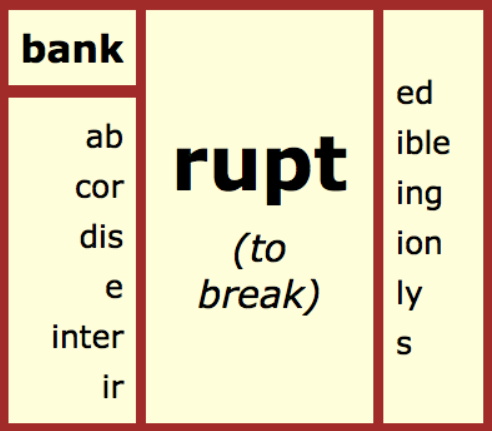
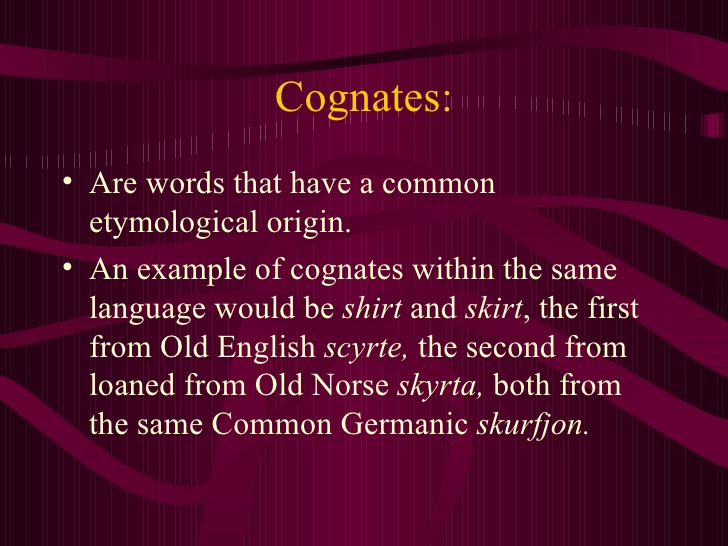
Words that are related by etymology to the same root or have a commonality between languages are known as cognates. People with large vocabularies seldom attain such a high level of fluency by memorizing words one by one, as if reading a dictionary. They learn the various parts and pieces of words, then stick them together to make full words, or cognates. They may also go in reverse by reducing a cognate down to its origin to come up with a meaning.

A root term can have dozens of cognates, so it is much more effective to learn one root and extrapolate it out than learn each variation of the word individually. This is why learning cognates is stressed in foreign language courses. There is also such a thing as false cognates, but that discussion will have to wait for another day.
etymology

Now that we’ve humored Hugh and dipped our toes into the deep end of the language pool, the real question is, “How can one expand their literacy with etymology?” The answer isn’t complicated, but does require some effort and dedication.

First, do a lot of reading, preferably at or just above your reading level so you will be challenged. When you come to a word you don’t know, look it up in an etymological dictionary (yes, such a thing exists!). Take a moment to study the fragments and roots of the word as opposed to only the word as a whole. When you come across another word with the same components, try to derive the meaning based on what you know about the etymology of the term. Second, make an effort to use the new words you learn in your written and spoken interpersonal communications. Remember, context counts!

I know this all sounds tedious and slow, but with practice, you will be amazed at how fast your fluency and skill increases. The more you do it, the more seamless the process will become. The benefit is threefold: Larger vocabulary, greater reading comprehension, more effective interpersonal communications. Whether you are a high school student, a multi-degreed scholar, or a small time blogger (like me!), anyone can better themselves with etymology.

Regrettably, the day when etymology and linguistics are taught to grade schoolers is not on the horizon. Until then, I feel like one tiny little voice trying to convince others that obscure English department sub-specialties are worth the effort it takes to learn on your own.

Thanks for asking, Hugh! I hope my answer leaves you and everyone in a better place.

haircut

Getting A Haircut: Leave Your Worries On The Floor.

I keep my hair really short because it’s practical. Being a curly-haired mophead may be cute when you’re fifteen years old (and it impresses the girls!), but as an adult whose time is more important than a well maintained mop, I find it so much easier to cut it off and eliminate the need to deal with it in the first place. A #3 on the top and a #2 on the side, please! And no sideburns. As I sat in the barber’s chair today, it occurred to me that getting a haircut is in many ways a metaphor for renewal and starting fresh.

The barber buzzed away and the clippings dropped to the floor. I started feeling better, like I was getting rid of a problem. By the time I stood up and briefly admired my new look in the mirror, I was in mood elevation mode. I walked out of there refreshed and ready. All of this because of a haircut?

Yes. Because of a haircut. Maybe I’m reading too much into it, or maybe I unconsciously tend to stop for a haircut when I’m already in a good mood anyway. Yet, I don’t think it’s a coincidence that I’ve never seen anyone leaving a barber shop with a frown on their face. Is this is why women like going to their hair dressers so much, and sometimes spend several hours there? Do they know something?

My standard haircut takes mere minutes. Guys do not linger in barber shops for hours and hours. We quickly take care of business and leave. The end result is clean cut and trimmed, with a new attitude on the side. A haircut is not just a basic personal grooming habit. It is often part of a ritual, a preparation for something bigger: A wedding, a high school prom, a new job, entering the military, going on vacation. Something good almost always follows a haircut, and even when it is not a prequel to a big event, we still have the satisfaction of feeling cleaned up and fresh as we go forward with ordinary life.

The more infrequent something is, the more special it will be. The good feeling that comes from getting a haircut might not happen if I went to the barber every week. It might not be the haircut itself but whatever comes after it that makes us subconsciously associate going to the barber with feeling a good vibe. The anticipation that something positive is about to happen oozes into our psyche; the bad attitude has been cut down and left on the floor to be swept away.

hug

When All You Have Is A Hug.

By: Chris Warren.

Luckily, it is rare when I find myself in a situation where someone important to me is in a lot of trouble and pain and there is absolutely nothing I or anyone can do about it. No matter how much I want to help them, no matter how much I care, no matter how much I empathize with them, none of it changes the ultimate outcome. When there is nothing left to give, or more appropriately, nothing to give, all that is left is the power of a hug.

I find myself in such a situation right now; it involves a close friend who is going through a painful and difficult period and all I can do is stand back and watch. She doesn’t deserve it. Then again, does anyone? Fate can be a both a bastard and an angel, often at the same time. It’s also indiscriminate. Good and evil happen to everyone at some point in their lives. Evil can be avoided to some extent with good judgement and money, but sooner or later, the bastard is going to catch even the smart, the rich, and the lucky.

I sat in a hospital lobby with my friend for several hours late into the night while waiting for her husband to arrive. The place was quiet, very well appointed, with deep comfortable chairs and soft light. They even had a fireplace! My friend did about 80% of the talking, describing in great detail the storyline that was soon going to end sadly in that hospital. The whole scene: The nice furniture, fireplace, and personal conversation made me feel like I was in a therapist’s office, except I was the therapist.

Other than listening and hugging, we bystanders in an untenable position. We can’t really help, and we can’t just stand there either. For those who are hurting, an attentive ear and a hug go a surprisingly long way. A hug has warmth. A hug has hope. A hug has meaning that cannot be expressed with words. A hug has power. A hug is what you have when you have nothing else. And that’s a lot.


music

When Music Mattered.

By: Chris Warren.

I am a huge consumer of music. My iPod is nearly full and I’ve been a subscriber to SiriusXM radio for over ten years. I listen to jazz standards and screaming thrash metal and classic rock and country and everything. A lot of what I’m into is just for entertainment, but some of it says something meaningful to me. What has become apparent is that new music does not seem to say anything at all.

Rewind back to the 1960s-1970s Vietnam era. The war was in the headlines every day. We The People, particularly the young people, were getting sick of it and the music of the time reflected the sentiment. It was a Golden Age when music was not just about making a profit. It was a vote, an editorial, and a prayer all rolled into one. You may not have agreed with what they were saying, but they deserved respect for the effort they put into saying it.

Today, not only does music have little to say (unless killing cops and having sex is “saying something”), it does not take a whole lot of talent to say it. Carefully crafting chords and downbeats, you know, actually singing and playing an instrument, has been dispensed with. Now they just slap some junk together and let a computer sort out the details. All bow down to Auto-Tune.

There is an episode of the animated TV show South Park where father Randy Marsh, disgusted by the kids’ idea of “talent” as hitting high score on the video game Guitar Hero, tries to show them the artistry of Kansas’ classic Carry On My Wayward Son as performed on a real guitar. Predictably, the kids are appalled. Satire and comically horrible vocals notwithstanding, that one short scene encapsulates the generational disconnect about music. It’s not about musicianship or artistry, it’s about memorizing what button to push or having a good marketing agent.

The computerization of music is not necessarily bad. Times change, technology moves forward, and I love my iPod and SiriusXM. I’m not old enough to have ever owned an 8-track tape, but I know I don’t want them back! What is bad is the complete lack of effort and thought put into modern music. Led Zepplin, Styx, Bruce Springsteen, Billy Joel…not a single one of them could get a recording contract as a new act today. Their music is nowhere near shallow and superficial enough for what sells now.

music

The social commentary and protest songs of the 60’s and 70’s are still relevant and still have a large following, not just because the music is well composed and performed, but also because decades later it still isn’t done telling its story. Anyone want to bet if Justin Bieber or Nicki Manaj will be considered artistic treasures forty-plus years from now?

The political climate probably has a lot to do with the lack of dissent in modern music. In politics, there are very few fence sitters. Music is a commodity and bands are run like corporations. As such, they go only for what sells. The few that drift out of the center lane accept that by embracing one side they are volunteering to be outcasts to everyone else. Socially conscious music may be virtuous and philosophically pure, but it seldom pays the bills.

Justin Bieber will never have to worry about one of his songs being hijacked for a political or social cause.

We have an election year coming up, and as sure as the weeds grow every spring there is no shortage of aging hippy rock stars whining that they don’t want their music used in a particular party’s or candidate’s campaign. Never mind that the campaigns paid licensing fees for the legal right to use the music (although the law does give the artists some say in the matter). And never mind that a lot of these old bands get a badly needed career boost from the publicity that comes from their songs being used by a political campaign, even if it’s for a candidate they disagree with.

The 60s and 70s antiestablishment spirit still burns bright in the hearts of the old rock legends who are still around. Their objections today seem rather petty compared to the statements they were originally trying to make with their art, yet I admire them for sticking to their principles. For sure, Justin Bieber will never have to worry about one of his songs being hijacked for a political or social cause.


christmas

A Christmas Message From Twenty First Summer.

By: Chris Warren.

Christmas means different things to different people. For some, like me, it’s a religious holiday celebrating the birth of Jesus. For little kids, it’s a joyful time of toys and presents. For people employed in critical professions, Christmas is another day on the job.

Sadly, for many, Christmas is a very painful reminder of their loneliness and isolation. A battle with addiction. Homelessness. Unemployment. Estrangement from family. Thoughts of suicide.

Christmas is the seriously ill patient, grateful for having made it another year and nervously concerned that it might be their last.

Christmas is the old man sitting alone and forgotten, contemplating the lifetime of bad decisions that brought him to this time and place.

Christmas is the unemployed veteran who gave so much of himself to protect the liberty of others and was rewarded with broken promises.

Christmas is the struggling single mom and her kids who are squeaking by for now but have no idea what life will be like in another month.

Christmas is the oppressed and persecuted all over the world who cannot find even one moment’s peace or the simplest of freedoms.

We are commanded by God to watch over and care for the less fortunate. Non-believers will question and even mock this concept with statements along the lines of “if your god is so powerful and almighty, why does he let people suffer?” God does not want programmed robots working for Him. He gave all of us a free will. Doing good works is our way of showing others our love for Him, but He rigged it so we could decide for ourselves if we were going to answer the call. When the needs of the hungry and the poor and the sick go unaddressed, it’s not because God “let” it happen. It’s because we mortal sinners let it happen.

Yet all is not dreary and bleak. Christ himself  taught that there is always hope for those who believe. Christmas exists for the sole purpose of letting everyone know that through Him is the path to a better place, even if that “better place” is not on this physical Earth.

For sure, Christmas is a celebration and there is nothing wrong with partaking in parties and food and gifts, unless the only reason you’re into the holiday is because of parties and food and gifts. When the egg nog wears off and the sales are over and the decorations are put away, what, or who, do you truly care about? Are you hearing the message, or was it just a party?

Christmas is December 25. And January 17. And March 5. And July. 10. And October 8. And so on. You get the idea. God is real. Are you?

Warm Blessings and Merry Christmas from Twenty First Summer.

advice

What Advice Would You Give Your 17 Year Old Self?

By: Chris Warren.

The other night I was on the phone with a buddy I’ve kicked it around with since we were young brats. We are still close friends and we sometimes get carried away while shooting the breeze and yapping about whatever. What started as a five minute check-in call turned into a lengthy introspective. It was a sometimes serious, mostly funny conversation, contemplating what advice we would give our seventeen year old selves. As it turns out, it’s not really an original idea.

If I were having a face to face talk with my seventeen year old self, the list of advice would be far longer than can be fit into a few hundred words on a commentary blog. But there are two Big Things old Chris wants young Chris to know:

“First, you somehow got it in your head that you have to go it alone on everything, but there are a lot of people on your side, and letting them in, even just a little, would make your world a lot better. There is no shame in asking for help, nor is there any particular glory in struggling by yourself. Decades from now you will still be doing everything yourself, but by then you will have become a very resourceful person and learned to work it to your advantage.

“Second, take yourself less seriously: You brood over inconsequential junk that you’ll barely remember five years from now. I understand that friends, school, and life seem very heavy to you. It may shock you to hear me say this, but the world you are in now, the one that gives you so much stress, is not reality. It’s not even close. Everything gets harder from here. Your life will never be as easy as it is at seventeen. Toughen up and stop thinking that no one has bigger problems than yours. Not everyone who superficially treats you well is your friend, and not everyone who kicks you in the balls is your enemy. Learn the difference. If you can’t handle your present day problems, then there is no advice that will save you from becoming hopelessly dysfunctional as an adult.”

advice

Today I hear young people say stuff that sounds amazingly similar to things I said and felt myself when I was in their shoes. In their limited life experience, their problems seem very real. I feel a responsibility to help them gain some perspective and make them see that these things do pass.

One of the worst things an adult can do is trivialize a kid’s problem, even if the problem is, in fact, trivial. Yes, I get it: Breaking up with a girl/boyfriend after a two month “relationship”, or not making the team, or not having a date for the dance, or not getting cool new clothes don’t rank high as the most profound concerns in the world, unless of course your world is not that big to begin with. That is the viewpoint teens see things from. My advice to my seventeen year old self was to take myself less seriously. The advice goes the other way for the adults: Take kids’ concerns more seriously, because to them, making the team, or whatever, is a pretty big deal.

When I think back to those times I am somewhat embarrassed about how much I used to let trivial things bother me. I am certain that pretty much everyone my age feels the same way. If we all had the benefit of our adult selves counseling our teenaged selves, would we follow our own advice? I don’t think I would have listened. The paradox is that had I listened to my own advice, I would have missed out on the failures that resulted in the life experience that allowed me to give the advice in the first place. As the cliché goes, no pain no gain, at least until someone discovers time travel. My seventeen year old self will just have to accept the growing pains and wait a few more decades to see that my older self was right about everything.

gift

Ending The Gift Quid Pro Quo.

By: Chris Warren

One major holiday is done and we’re less than a month out from Christmas, a time when gift giving, for most of us, is a true expression of love and gratitude. For many others, they give stuff, they get stuff. In the end it’s a zero-sum game. To the extent that I can, I’m going to end the gift giving circle of absurdity.

Years ago my parents put their foot down and insisted that they wanted no gifts for birthdays, Christmas, or Mothers’/Fathers’ Day while at the same time retaining their “right” to give stuff to us kids. I know it’s a double standard, but they are the parents so we respectfully deferred to their wishes. At first I thought they were just being difficult. My parents worked hard and retired well. Having reached a place in their lives where they are comfortable, there isn’t very much anyone can give them that would make a big difference. Now I understand the psychology behind their demand: Not accepting gifts is my parents’ statement of content. Giving them more will not make them more happy.

Oddly, they do not seem to mind and are genuinely pleased if I give them a modestly-priced random gift for no particular reason. If I’m walking through a store and in a moment of serendipity spot something I know either of them would like, I’ll get it for them. My dad loves Guinness beer but never buys it for himself. So every now and them I’ll bring him a twelve pack, and he accepts it without any fuss as long as the gift is not tied to any special occasion. I don’t get it, but whatever.

If I spend $100 on someone, and they spend $100 on me, then what’s the point? Where are we going with this? How about if we both just spend the same $100 on ourselves call it good? All of the people in my life who I care enough about to buy gifts for already do little favors and help me throughout the year. I’m very blessed and I know it. There is no need to give me something on a special day once a year.

Although there are none in my circle that I’m aware of, the worst offenders are those who will try to predict what someone will spend on them, then go out and find a similarly-priced gift to give in return. They see gift giving as a social obligation and not a true expression of the season.

In my experience, the people who have the least usually give the most. To understand this concept, it’s important to point out that money does not mean the same thing to everyone. An unemployed guy who spends $10 on a gift is not looking at that cash the same way a very rich man who spends the same amount would.

A few years back, my nephew gave me a jacket for Christmas. It was a very nice jacket that I really liked and it probably cost him about $40-$50. Fifty bucks or so is not a lavish amount of money to most of us, but to a young college age kid putting himself through school on a ten dollar an hour job, it’s a significant cash outlay. I was beyond flattered and could see the glow in his face when he gave it to me. I deeply thanked him and gave him a big hug, then urged him to return it and use the money for school. He was adamant that I keep it, so I complied. Every time I put that jacket on, I smile and think of him. My nephew’s selfless spirit of giving was his real gift to me.

I refuse to participate in any gift quid pro quo. I’m going to borrow a page from my parents’ book of wisdom and push back against receiving gifts but still give them as the mood moves me. I don’t have everything I want in this world, but I’m a happy guy and am satisfied with giving gifts with no expectation that I’m owed something in return. This time around, for me, the greatest gift is not wanting any.

Thankful People, And The Other 364 Days.

By: Chris Warren

I must confess: I’m not into Thanksgiving, as in the holiday. It’s always great to have a huge meal and visit with nice people, but in my family we don’t need a special time for that. The day founded by early American colonists as a has evolved into “Christmas Lite,” and I’m not taking the thankful bait. It’s now officially a hollow, feel good celebration when for one day everyone raises their glass to the idea of gratitude but does not think much of it the rest of the year.

Thankful People have two common traits: First, they are never superficially grateful. They don’t post trite memes on Facebook and call it good enough or say “thank you” to strangers as a matter of courtesy more than true feeling. They will bring cookies to the neighbor who shoveled their snow without being asked, or send an email to praise the flight attendant who went very far out of their way to assist an elderly passenger in a wheelchair (both of these examples actually happened). If the bulk of your appreciation involves sitting around a table once a year talking about how thankful you are, then all you are really doing is making yourself feel good. Thankful People don’t just say they are thankful. Thankful People know it’s not about them. They act thankful. They make others feel valued, all the time.

Second, Thankful People cheerfully do things for others and are grateful for the chance to be of service. That sounds counterintuitive: Shouldn’t the one who hands out the blessing be the recipient of thanks? Yes, but appreciation is never a one way street. Every kind act originates from someone’s desire to make the world a little better. Knowing they have accomplished their goal is in itself a reason to be thankful. The Thankful Person puts the “giving” in Thanksgiving.

I certainly don’t have a problem with the concept of being thankful, or for that matter a day to commemorate it. Yet I can’t help but notice that Thanksgiving, the holiday, has lost its real meaning the same way hardly anyone thinks about why we have a Memorial Day or Labor Day or any other fill-in-the-blank-Day. It’s become another easy excuse to stuff our faces and watch sports on TV.

The fact that there is a need for a Thanksgiving is evidence that we don’t have enough of it. Why and how have we reached a point where gratitude requires its own special day? Thankful People are already living it, and everyone else won’t get the message anyway. What are they doing the other 364 days of the year? If you feel different on Thanksgiving than you do every other day, then you are doing something wrong.

radical islamic terrorists

Hear Ye, Hear Ye! All Good Citizens To Arms!

By: Chris Warren.

During the early history on the United States, the everyday person existed in a lifestyle of survival. There was no such thing as running to the store for a forgotten item. There was no organized public safety. There were no weekends off. Food, water, shelter, heat, clothing, everything, came out of one’s own hard effort. The settlers had to tap into their confidence, independence, and sense of inner strength, or die. Recent world events perpetrated by radical Islamic terrorists remind us why now is the time for all Americans to reclaim their independent Colonial spirit and personally stand up to the threats that seek to destroy the freedom the United States has sacrificed for over the two-plus centuries of our history.

Much has been said by world leaders about what can, should, or will be done about radical Islamic terrorists (note: unlike Barak Obama and the entire Democratic party, I will use this exact term throughout this article). The radical Islamic terrorists are not “contained.” They are on the move and expanding beyond the Middle East. Next stop: The United States. What are you, good citizen, going to do about it?

That was not a rhetorical question. I’m being totally serious: What are you, good citizen, personally going to do about radical Islamic terrorists? If the answer is some variation of “I can’t personally do anything,” or “Let the government deal with it,” then you are are unwittingly complicit in helping the radical Islamic terrorists achieve their goal and sadly disconnected from the spirit of the Colonial freedom fighters who birthed this great nation.

You are either armed or you are a soft target. It really is that black and white.

The most important and meaningful personal response to radical Islamic terrorists is having a way to defend yourself and by extension your country. You can’t (and shouldn’t) totally avoid “soft targets” such as shopping malls and sporting events. And there is no real defense against a suicide bomber or a maniac who takes over an airliner. But that is a weak reason to do nothing. There are measures anyone can take to have an advantage over most threats and not be a soft target yourself.

Being a hardened target involves carrying a gun at all times and knowing how to use it. The anti-gun American left is entitled to their old tropes and I’ll gladly shut up and permit them to prattle uninterrupted on the condition that they openly admit they are ok with being a walking soft target and they are ok with the thought of having absolutely zero options except luck if radical Islamic terrorists (or gang bangers, or any other form of social excrement) come to kill them and their families. I fully respect the anti-gun liberals’ decision to call 911 and sit quietly in their “gun free zone” piousness while they wait their turn to have their brains splattered on the wall. I will be busy shooting back. You are either armed or you are a soft target. It really is that black and white.

In Colonial times everyone was armed because there was a legitimate need to be. The frontier was a place were the perils were numerous and unpredictable; being caught without a means of defense was often fatal. Imminent mortal danger may seem far removed from modern life in the USA, and that’s exactly what the radical Islamic terrorists want you to think. The need to carry a gun is still as real as it was over two centuries ago. Political and military solutions are beyond the practical control of the average citizen, but there is quite a bit that we can do as individuals. The Second Amendment is the great equalizer.

All good Americans need to embrace the spirit of the Minuteman: Prepare yourselves and answer the urgent call to arms in defense of your own liberty. Do not wait until the radical Islamic terrorists are at your door and then hope others will save you. Protecting freedom is not the sole domain of the police, the military, or the government. It is your heritage. It is your personal duty.

Editor’s note: If you enjoyed this article, then you may also like my other Second Amendment related post, We Walk Quietly Among You. 


off grid

Introducing Off Grid Ham

By: Chris Warren

I am very excited and pleased to announce the launch of my new spinoff site, Off Grid Ham.

Twenty First Summer will continue as usual. I created Off Grid Ham as a separate platform to discuss technical topics related to amateur (ham) radio, electronics, and alternative & off grid energy. I feel this is the best way to serve two very different reading audiences.

I know a lot of technical people enjoy Twenty First Summer, and I hope all of you stick around! To dive deeper into the geeky stuff, please add Off Grid Ham to your reading list. If you are not a technical person, come on by Off Grid Ham anyway…you never know what you’ll learn.

New articles will not appear on Off Grid Ham on any particular schedule. If there is a topic you’d like to see me address, then please let me know and I’ll do my best.

It is because of the success of Twenty First Summer that I have the confidence to try a new venture. To everyone, no matter if you are a technogeek, a fellow blogger, or just a curious onlooker, thank you so much for your loyalty and goodwill.

I hope to see you all Off the Grid!